What is a water quality survey? Differences from water quality testing and how to proceed [Basic Knowledge]
Just taking a sample once and measuring it won't give you a grasp of the water's condition? This explains how to conduct water quality surveys by assembling data from locations, times, frequencies, and on-site records.
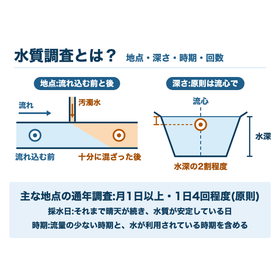
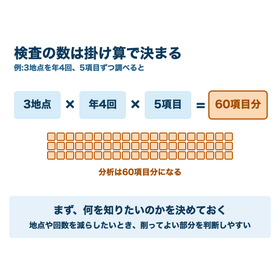
When you want to know the condition of the river flowing near the site, or the water in the ponds and waterways on the premises, taking a single water sample for analysis will only provide you with the values at that moment. In this article, we will refer to each instance of taking and analyzing water as "inspection," while the overall effort to determine the condition by deciding when, where, and how many times to sample will be called "survey." ■ What does the "principle method" indicated by the government mean? The Environmental Agency (now the Ministry of the Environment) provided a notification in 1971 titled "Water Quality Survey Methods," which outlines the fundamental methods that prefectures should adhere to for the continuous monitoring of public water areas and the investigation of wastewater from factories and businesses. It is stipulated that while this method serves as a principle, effective surveys should be conducted considering the specific conditions of the water area in question. The targets include rivers, lakes, coastal areas, and wastewater from factories and businesses, with guidelines for timing and sampling locations specified for each. ■ Surveys are categorized by purpose This notification categorizes surveys into monitoring measurement surveys to grasp the status of environmental standards, standard-setting surveys to obtain data for establishing criteria, and sediment surveys to examine the mud at the bottom. If the purposes differ, the items to be measured will also change. Please feel free to consult with us first.
- Company:トリイ
- Price:Other